Skip to content

Universal Swapping System

A universal battery swapping ecosystem built to eliminate long charging times and range anxiety. A Hybrid Battery System, an Intelligent Battery Swapping Station and a Charging & Battery Management System work together to deliver fast, safe and efficient battery swaps across multiple EV platforms.

Inventor

Keshav Gupta

Public survey

30,000+ participants

Status

Prototype ready for real-world testing

What We Are Building

Our innovation

We are developing a universal battery swapping ecosystem to remove the two biggest obstacles in electric mobility: long charging times and range anxiety. Three core products work as one system, so a rider exchanges a discharged battery for a tested, fully charged one instead of waiting at a charger.

A functional prototype has been developed and internally tested. The next stage is controlled real-world validation, OEM integration, independent technical assessment and preparation for commercial deployment. Battery swapping is a complementary option for compatible vehicles; conventional charging remains an important pillar of the EV ecosystem.

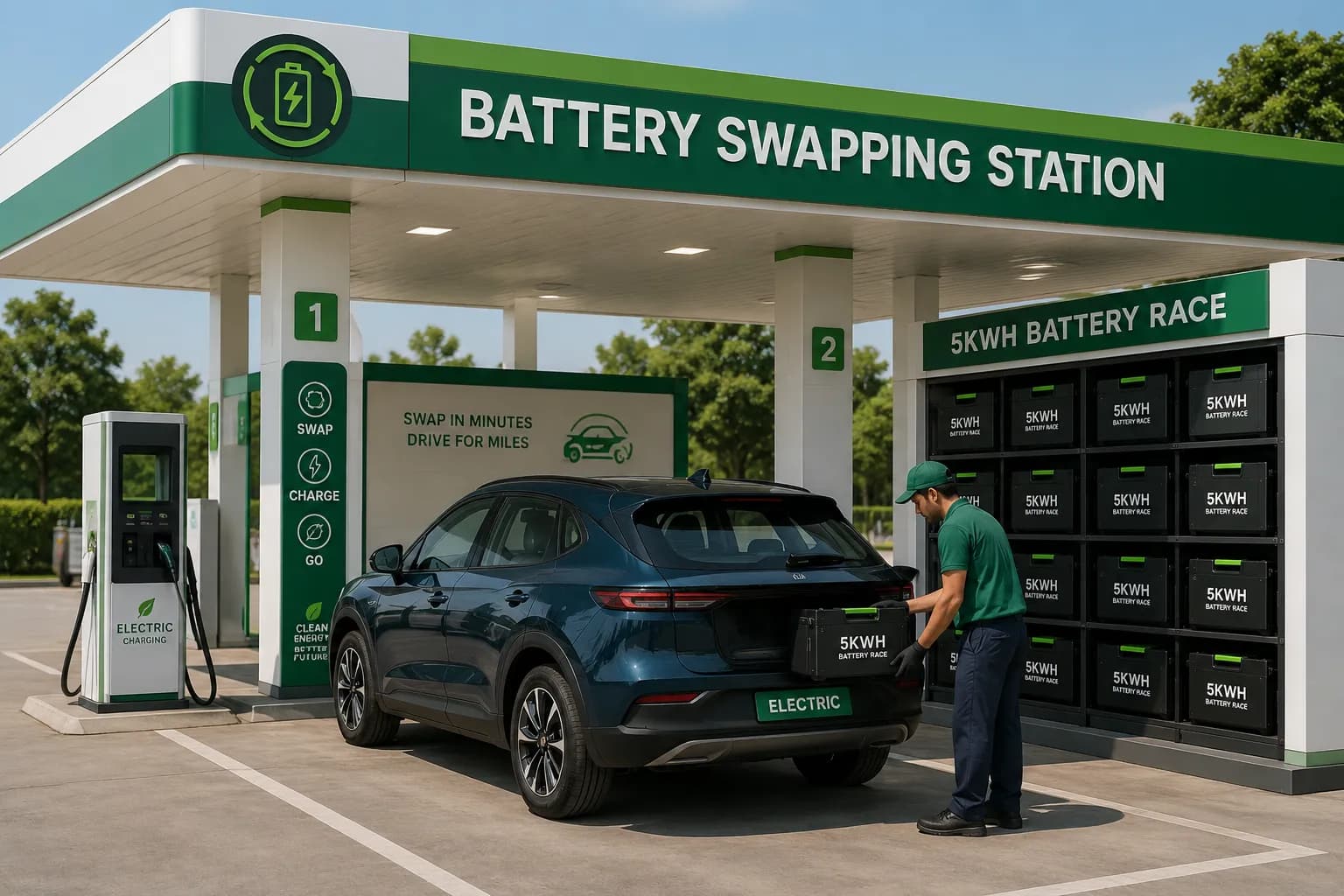
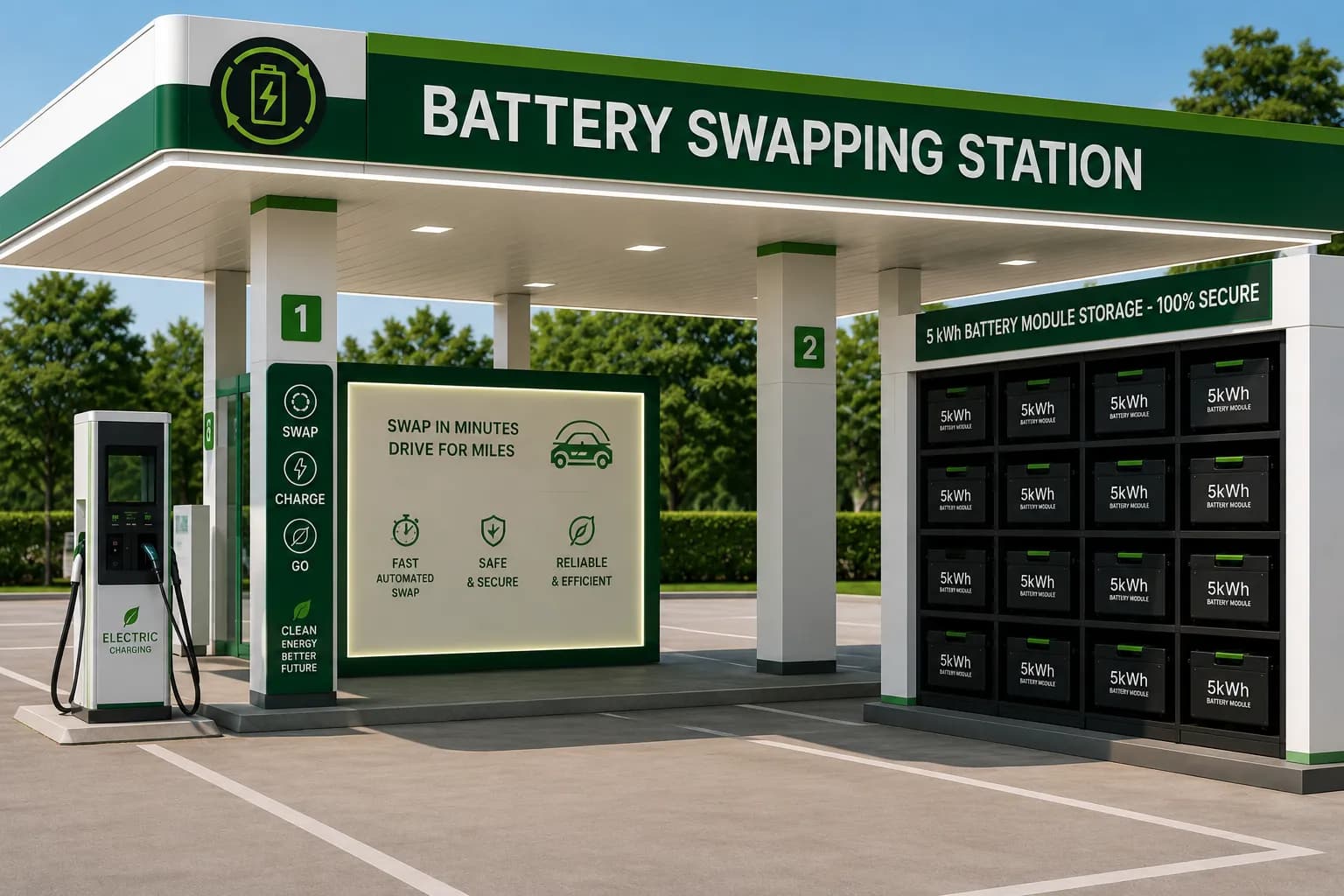
Amigas battery swapping station forecourt with swap bays and battery module storage
Why This Is Needed

Why is electric vehicle adoption still low?

To understand the challenges, we surveyed more than 30,000 people and identified four common reasons behind the low adoption of electric vehicles.

  • 01

    High initial cost and long charging time

    • Higher upfront price than petrol or diesel vehicles
    • Several hours for a full charge on a standard charger
    • 30 to 60 minutes even on a fast charger
  • 02

    Limited driving range

    • Lower driving range than fuel vehicles
    • Reduced performance in extreme weather
    • Battery drain with AC or heating in use
  • 03

    Charging infrastructure problems

    • Too few public charging stations
    • Unreliable electricity supply
    • No charging setup in apartments or rural areas
  • 04

    Battery life and replacement concerns

    • Battery degradation over time
    • High replacement cost
    • Safety risks such as overheating or fire
    • Uncertain resale value
Our Innovation

Three products, working as one

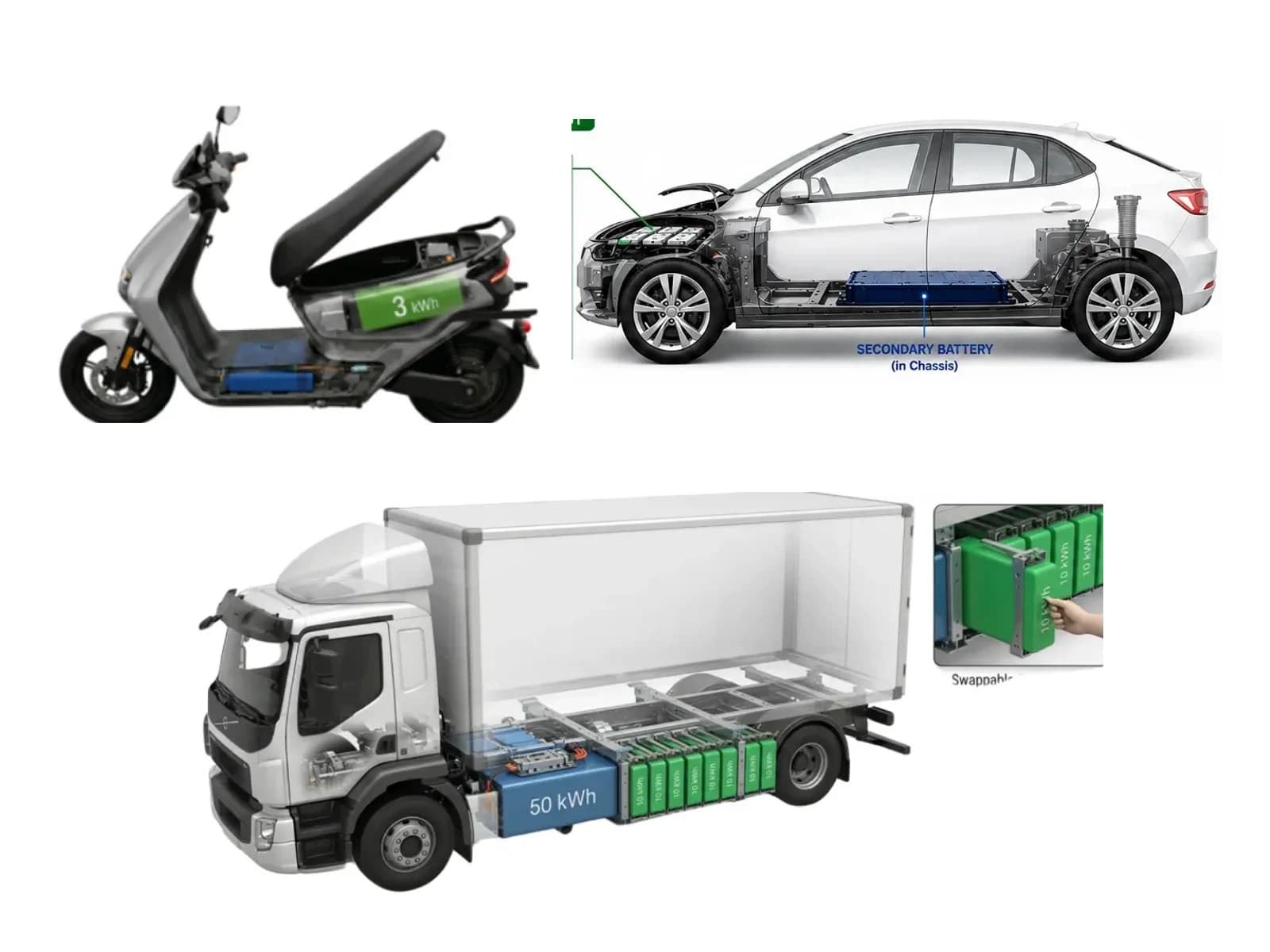
Swappable modules fitted to a scooter, a passenger car and a heavy-duty truck1

Hybrid Battery System

What it is

Every vehicle carries two separate batteries with defined roles. The Green Battery is the swappable primary pack, available in 3 kWh, 5 kWh and 10 kWh variants. The Blue Battery is a fixed secondary pack integrated into the chassis.

How it works

The battery management system monitors the primary pack's state of charge. When it is 90 percent discharged, the vehicle switches to the secondary pack automatically and keeps running. The primary pack is exchanged at a swapping station, while the secondary pack can be recharged at any standard EV charger.

  • Green Battery: swappable primary, 3 / 5 / 10 kWh
  • Blue Battery: fixed secondary in the chassis
  • Automatic switch-over with no interruption
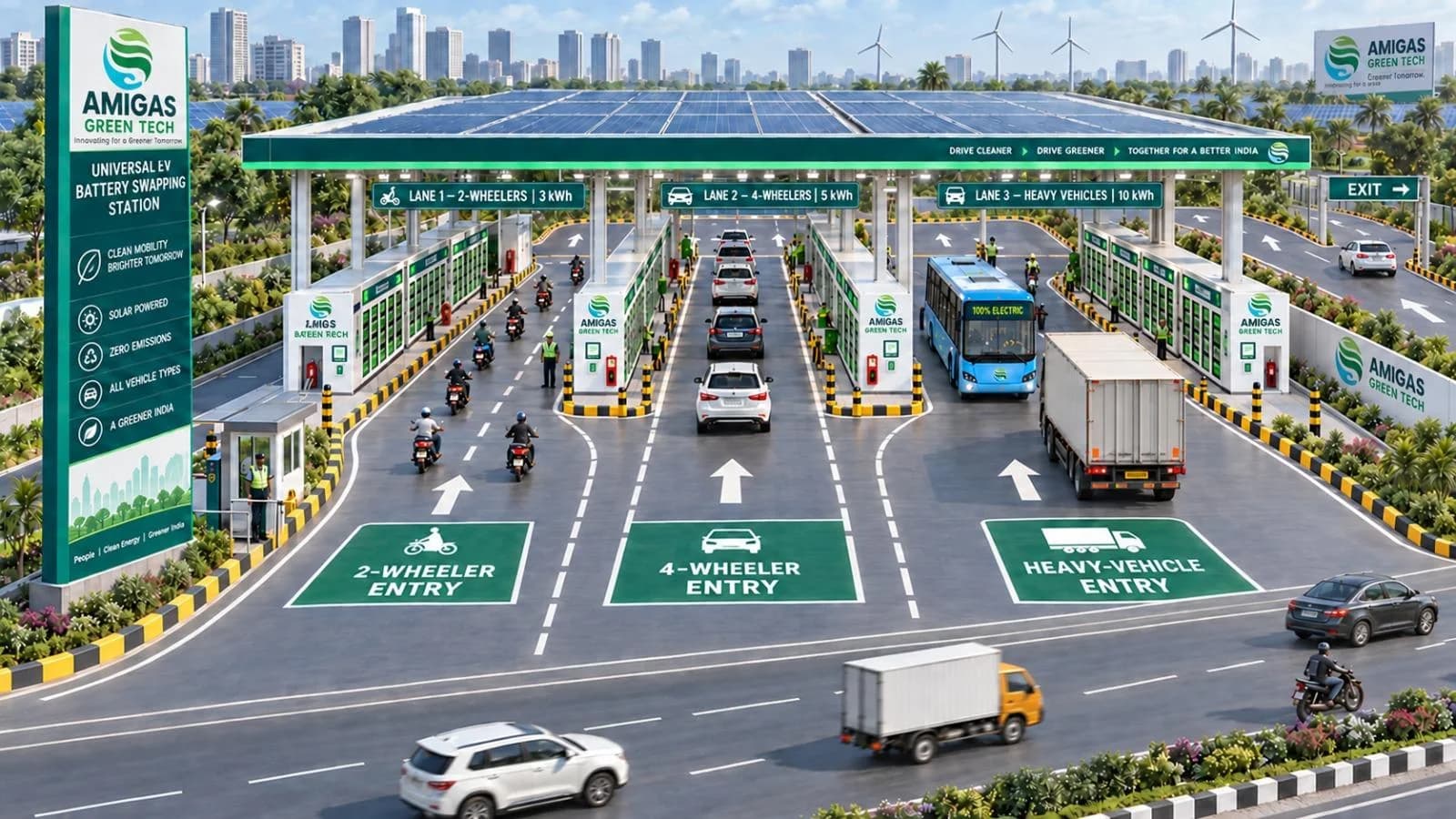
Multi-lane Amigas swapping station with separate entries for two-wheelers, four-wheelers and heavy vehicles2

Intelligent Battery Swapping Station

What it is

When a customer arrives, the operator verifies the customer, vehicle compatibility, battery identity and warranty status before starting the exchange. The swap takes about five minutes for light vehicles, with category-specific handling for larger ones.

How it works

Every returned battery is tested automatically for health, stability and safety. Batteries that pass are charged and made available again. A battery that fails is locked in the system and removed from circulation, so only healthy, safe batteries reach customers.

  • Swap completed in about five minutes
  • Automatic health, stability and safety test
  • Failed batteries locked out of circulation
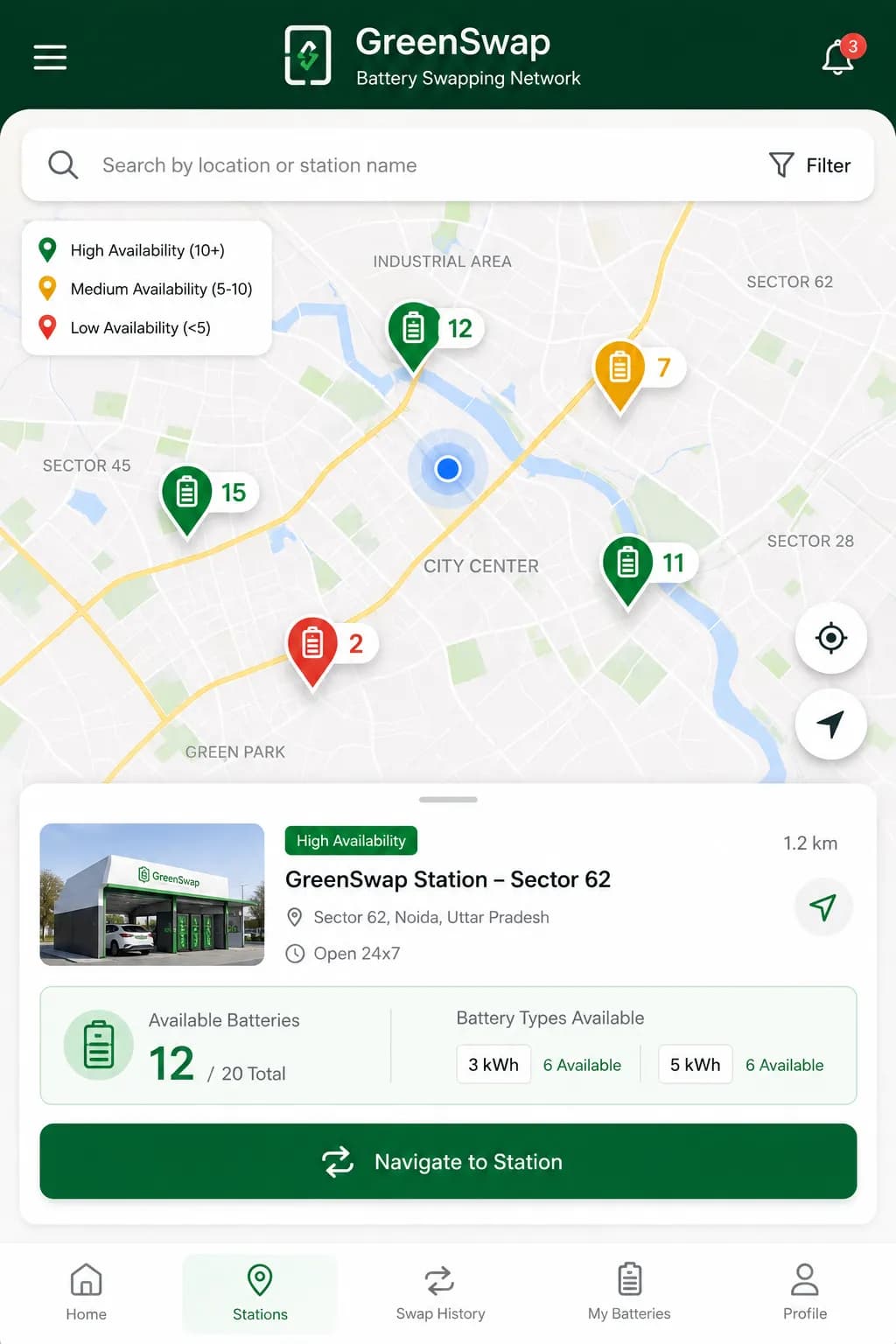
Mobile app showing nearby swapping stations and available batteries3

Charging & Battery Management System

What it is

A cloud platform that connects customers, battery manufacturers and swapping stations for complete battery lifecycle management, with real-time visibility into battery health, charging status, warranty and operational performance.

How it works

Customers use the app to find the nearest station, see how many charged batteries are available and check their warranty. Station operators monitor charging, diagnostics and inventory. Manufacturers get instant notice of defective batteries with full diagnostic reports, and manage service requests through to repair or replacement.

  • Customers: nearby stations, live availability, warranty
  • Stations: charging, diagnostics and inventory
  • Manufacturers: defect alerts and warranty tracking
Working Process

How a swap works

  1. 01

    Register

    When a customer buys an EV with a swappable pack, the manufacturer registers the vehicle and its batteries on the central platform for the warranty period.

  2. 02

    Locate

    The customer finds the nearest swapping station and the number of charged batteries available in the app.

  3. 03

    Switch

    When the primary battery is 90 percent discharged, the vehicle switches to the secondary battery and keeps going.

  4. 04

    Verify

    At the station the operator checks the customer, vehicle compatibility, battery identity and warranty.

  5. 05

    Swap

    The discharged battery is exchanged for a fully charged, tested one in about five minutes.

Battery Safety

What happens to a returned battery

StageSystem actionRelease condition
AuthenticateRead battery ID, model, chemistry, capacity and BMS communicationIdentity and compatibility confirmed
Initial diagnosisCheck voltage, current, SoC / SoH, cell deviation, temperature, faults and insulationPass permits controlled charging
Managed chargingApply chemistry-specific current, voltage and thermal limitsStable charging behaviour maintained
Health reviewReassess balance, temperature, efficiency and resistance near 80% SoCPerformance within approved limits
Final releaseComplete final safety and charge verificationQualified battery unlocked for service

Safety principle

Switching between batteries and unlocking a battery must be fail-safe and interlocked. Every transition requires verified isolation, contactor state, insulation status, connector temperature, communication integrity and battery authentication.

A digital passport for every battery

Each battery is linked to a digital identity that follows it through every portal, transfer, swap, diagnostic result, complaint and warranty action.

Permanent record

  • Manufacturer
  • Model and chemistry
  • Warranty

Live operating record

  • State of charge
  • State of health
  • Temperature
  • Cell balance
  • Internal resistance
  • Available power
  • Fault flags
  • Service history
Controls

Digital control priorities

  • Maintain one authoritative digital passport across every portal, transfer, swap, diagnostic result, complaint and warranty action.
  • Automatically isolate batteries that need attention and notify the responsible station and manufacturer teams.
  • Record the energy, charging, safety and service information needed for auditable operations.
  • Give access to data according to defined roles, consent, cybersecurity requirements and applicable law.
Roadmap

Readiness and validation path

  1. 1

    Where we are

    Functional prototype developed and internally tested

  2. 2

    Next validation gate

    OEM integration, independent technical validation and a controlled pilot

  3. 3

    Scale-up condition

    Certification pathway, operating evidence, commercial model and stakeholder approvals

Establish a safe, interoperable and evidence-led battery-swapping platform capable of responsible expansion across vehicle categories.

Impact

Outcomes of universal battery swapping

  • Reduced waiting time

    Replace a discharged battery with a fully charged one in less than five minutes.

  • Enhanced convenience

    Real-time information on nearby stations and battery availability.

  • Improved battery safety

    Automated health diagnostics mean only safe, healthy batteries are issued.

  • Digital warranty management

    Automated warranty verification and tracking improve transparency.

  • Interoperable ecosystem

    Batteries from multiple manufacturers work across one common network.

  • Lower operating cost

    Less downtime and maintenance, cutting total cost of ownership by up to 30%.

  • Faster EV adoption

    Better affordability, convenience and reliability drive faster uptake.

  • Less crude oil dependence

    More EVs on the road lowers reliance on fossil fuels and imported oil.

  • Less lithium dependence

    Enables sodium-ion batteries for a more sustainable, cost-effective ecosystem.

Energy Security

Why it matters for India

India depends heavily on imported crude oil, which leaves the economy exposed to global price shocks: a wider trade deficit, higher fuel costs, pressure on growth, a heavier subsidy burden and energy-security risk. Every vehicle that moves to electricity, and every battery charged from domestic power, reduces that exposure.

Infographic: India's economy remains vulnerable to global crude oil crises due to its dependence on energy imports
The Result

An electric vehicle without the charging fear

A charge that takes hours today becomes a verified swap in about five minutes, the battery is tested every time it comes back, and the whole ecosystem can reduce a customer's total cost of ownership by up to 30 percent.

See how we power it with solar
Research

Want The Detail Behind This Work?

We are happy to walk through the architecture, the prototype and the pilot plan with manufacturers, operators and government partners.