
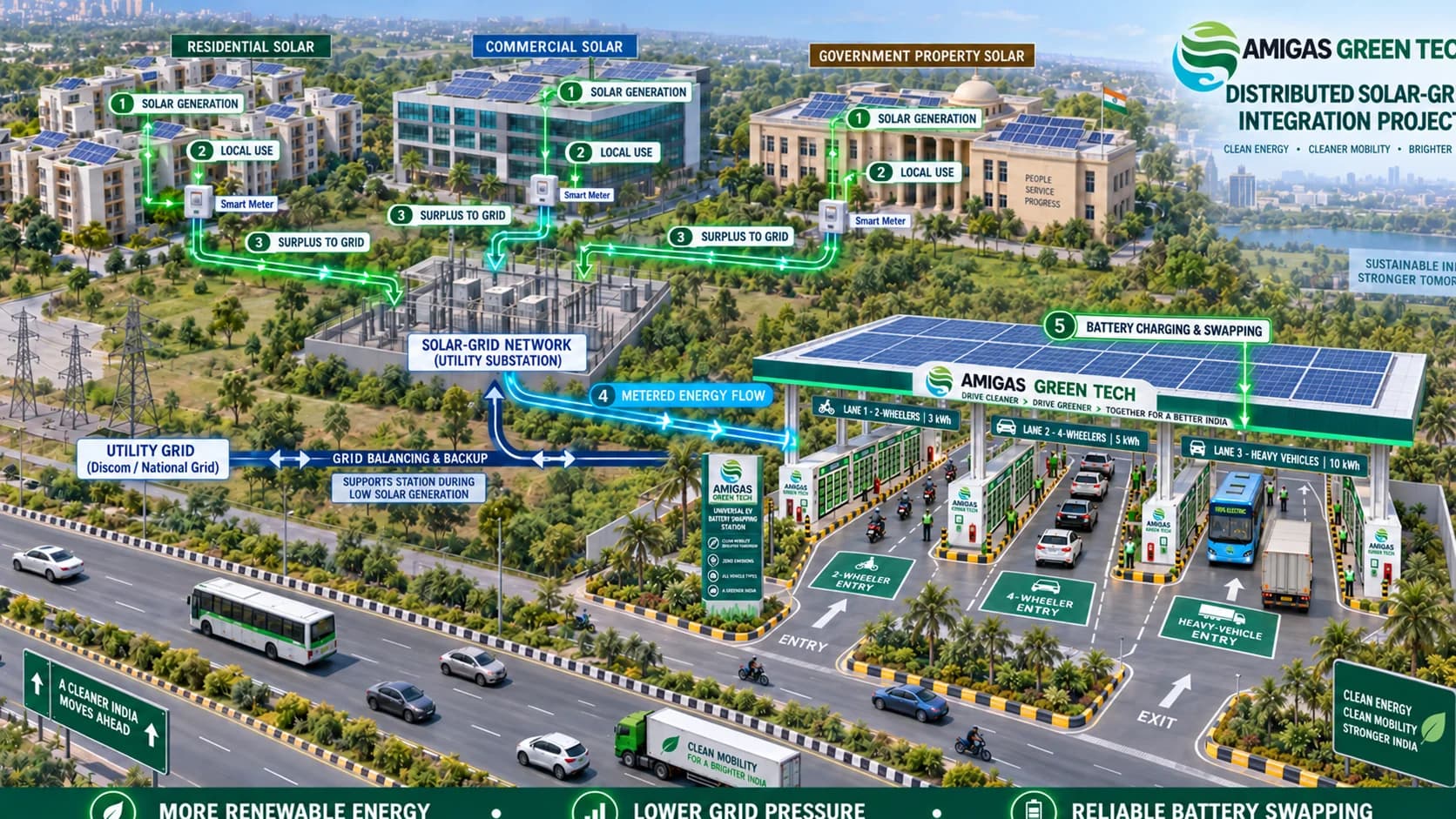
Distributed Solar-Grid Integration Project
A community-linked solar network that aggregates surplus rooftop and public-asset generation to power battery charging and swapping stations, keeping the grid as a controlled reliability and balancing resource rather than the default supply.
Project
Distributed Solar-Grid Integration
Energy model
Distributed and grid-assisted
Report
Concept, August 2026
Executive summary
Amigas Green Tech is developing an integrated clean-mobility ecosystem in which distributed solar generation supports the Universal Swapping network. The programme engages nearby households, businesses, institutions and public bodies to install solar photovoltaic systems on suitable rooftops and other technically viable spaces. Electricity generated serves the host site first; eligible surplus is then credited, supplied or allocated to participating swapping stations through an approved grid-interconnection and energy-settlement structure.
The model is designed to reduce the station network's dependence on conventional grid electricity, lower exposure to peak tariffs and supply constraints, improve local renewable participation and strengthen the environmental value of fast battery swapping. Station-level energy management, charging schedules and optional battery storage align charging demand with solar availability while keeping operations uninterrupted.
Core proposition
Local solar generation, approved grid connectivity, smart energy management and EV battery charging together form a scalable clean-energy foundation for universal battery swapping.
Project objectives
- Generate clean electricity as close as practical to swapping-station demand.
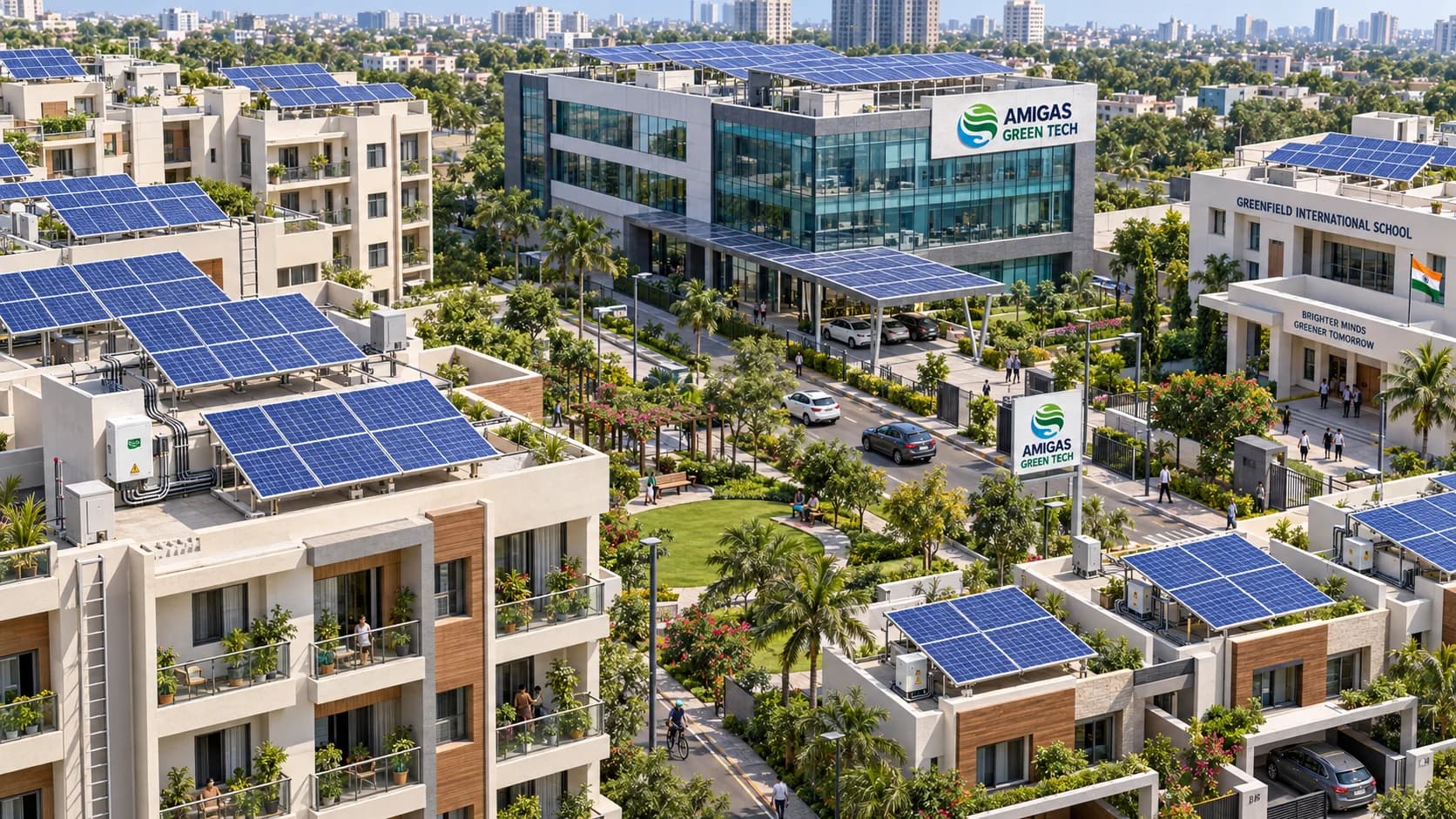
- Use suitable residential, commercial, institutional and government rooftops as distributed generation assets.
- Evaluate highway-adjacent, roadside and public spaces only after technical, safety, land-use and statutory clearances.
- Prioritise host consumption and establish a transparent mechanism for eligible surplus-energy transfer, credit or settlement.
- Coordinate battery charging with renewable availability without compromising service or battery safety.
- Reduce grid draw, peak-load exposure and lifecycle emissions across the swapping network.
- Create measurable community income, savings or participation benefits under approved commercial arrangements.
The project in brief
The Distributed Solar-Grid Integration Project is designed to support the growing electricity demand created by large-scale battery-swapping infrastructure while promoting greater utilisation of domestically generated renewable energy.
Under a preliminary high-throughput operating scenario, one major swapping station may serve approximately 50 to 60 two-wheelers and three-wheelers, 10 to 15 four-wheelers and up to 10 heavy-duty vehicles per hour. Depending on the number of battery modules exchanged, charging speed, battery inventory and operating schedule, the station's combined charging demand could approach 2 MW during peak operations.
To support this demand, Amigas Green Tech proposes a coordinated renewable-energy participation model involving suitable residential societies, commercial establishments, institutions and property owners located near participating swapping stations. Subject to technical feasibility, statutory permissions and mutually agreed commercial terms, participating properties may install rooftop or distributed solar-generation systems.
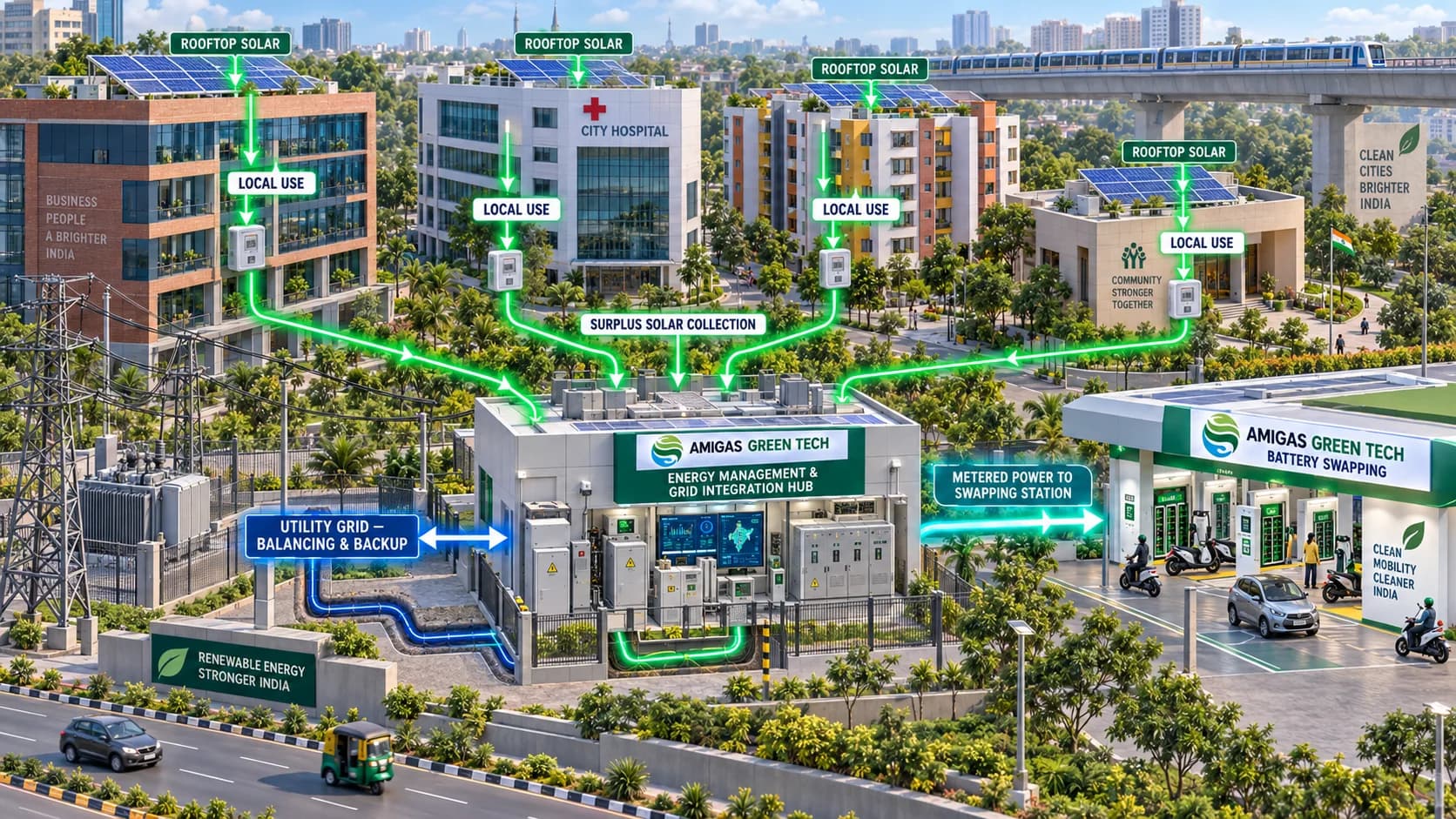
Participating property owners will first utilise an agreed share of the solar electricity generated at their premises. Eligible surplus renewable energy may then support swapping-station demand through approved grid interconnection, metering, energy-accounting and settlement mechanisms. The conventional electricity grid will continue to provide balancing and supplementary power whenever renewable generation is insufficient.
This coordinated model can reduce peak pressure on the electricity grid, increase productive utilisation of rooftop solar resources and create a transparent framework connecting renewable-energy generation with clean-mobility demand.
Why clean mobility needs local solar
Energy security and resilience
A diverse domestic energy portfolio strengthens India's resilience across global fuel markets, shipping routes and technology supply chains. More domestically generated renewable electricity gives India greater control over the energy used for mobility and supports long-term economic stability.
Environmental and grid value
EVs eliminate tailpipe emissions, and their full climate benefit grows as charging is increasingly supplied by low-carbon electricity. Solar-supported station charging improves lifecycle performance while aligning flexible battery-rack demand with solar-rich hours.
The grid remains the balancing layer, while battery safety, customer service and minimum charged-battery availability remain the controlling priorities.
India's solar opportunity
National progress on solar creates the conditions for demand-linked models that connect distributed generation with productive loads such as EV battery charging, subject to state regulations and utility approval.
- 164.59 GW
- Cumulative solar capacity
- 30.74 GW
- Grid-connected rooftop solar
- ~748 GW
- Estimated national solar potential
As of 31 July 2026
Included in the national total
National Institute of Solar Energy assessment
Source: Ministry of New and Renewable Energy (MNRE).
Current priorities
- 01
Distributed solar asset coordination
Suitable rooftops are spread across many owners, load profiles and approval conditions. Aggregation, standardised contracts and verified data make their contribution measurable, transparent and ready for coordinated planning.
- 02
Aligning solar generation with station demand
Solar output peaks in daylight, while swapping demand runs through the whole day. Intelligent charging schedules align renewable use with minimum battery inventory and forecast customer demand.
- 03
Grid interconnection and energy settlement
Energy accounting runs through approved utility and regulatory mechanisms. Net metering, gross metering, group settlement, open access and banking vary by state and consumer category, so each deployment uses the mechanism approved by its regulator and DISCOM.
- 04
Quality, safety and long-term performance
Structural assessment, approved equipment, professional installation, accurate metering and planned maintenance keep output reliable and operation safe, delivered by qualified EPC partners with defined O&M responsibility.
- 05
Role-based visibility and digital integration
Amigas, property owners, station operators, EPC partners and authorised government or utility stakeholders each see dashboards matched to their responsibilities, with battery and energy data linked through secure identifiers.
Programme vision
- Use distributed generation close to station demand.
- Give participating hosts priority use of their own solar electricity.
- Account transparently for eligible surplus under approved utility mechanisms.
- Coordinate charging with solar availability while preserving service reliability.
- Create replicable local energy clusters that grow with the swapping network.
Strategic fit with the swapping network
| Swapping requirement | Solar-grid response | Combined value |
|---|---|---|
| Continuous energy for charged inventory | Distributed generation with grid backup and optional storage | Higher service reliability |
| Rapid battery availability | Smart charging schedules prioritise solar hours | More renewable kilometres served |
| Network expansion | Modular solar capacity grows with station demand | Scalable infrastructure |
| Battery diagnostics and safety | Energy-management system coordinates safe charger loads | Controlled charging operations |
| Lower environmental impact | Local renewable generation displaces part of grid consumption | Stronger clean-mobility outcome |
End-to-end energy flow
- 01
Solar asset
Rooftop or approved public space
- 02
Host load
Local use first
- 03
Meter and grid
Measure and balance
- 04
Station EMS
Forecast and schedule
- 05
Battery rack
Safe charging inventory
The grid remains a balancing layer. It receives or accounts for eligible surplus when available and supplies energy when solar generation, contracted credits or station storage fall short. The design does not assume unrestricted private transfer of electricity between premises; the settlement method must be approved for each deployment jurisdiction.
How the two projects interlock
The swapping project decides how vehicles receive energy; the solar-grid project decides how a growing share of station electricity is generated locally, measured transparently and coordinated with the grid.
| Layer | Coordinated function | Shared control objective |
|---|---|---|
| Solar assets | Generate electricity at participating rooftops, public facilities and other suitable sites | Increase domestic renewable contribution |
| Grid and metering | Measure import and export and apply the approved accounting mechanism | Preserve lawful settlement and reliability |
| Station EMS | Forecast generation, station demand and battery inventory | Schedule charging without affecting service readiness |
| Charging racks | Charge authenticated batteries within BMS and thermal limits | Maintain safety and battery health |
| Digital platform | Combine battery, energy, settlement and performance records | Create auditable programme governance |
| Swapping service | Issue verified charged batteries to compatible vehicles | Deliver rapid, dependable mobility energy |
Day-to-day coordination
- Solar forecasts inform charging schedules while a minimum charged-battery inventory stays protected.
- Host premises get priority use of their own solar electricity where the approved arrangement requires it.
- Eligible surplus is credited, settled or allocated only through the mechanism approved by the DISCOM and regulator.
- The grid supplies balancing energy as solar output and station demand change.
- Stationary storage is added only where safety, reliability and economics justify it.
Proposed operating model
Every participating site is assessed, designed, approved, metered and digitally registered before its energy counts toward station operations. Physical electricity continues to flow according to the electrical network; commercial allocation or crediting of surplus follows the mechanism permitted by the relevant DISCOM, state regulations and contractual framework.
| Stage | Activity | Primary control |
|---|---|---|
| Identify | Map station demand and screen nearby rooftops and public assets | GIS, ownership and feasibility checks |
| Assess | Survey structure, shadow, access, interconnection and generation potential | Certified technical assessment |
| Contract | Define ownership, tariff or benefit, tenure, maintenance and exit terms | Written participation agreement |
| Approve | Obtain utility, electrical, building, land-use and other applicable permissions | Regulatory compliance gate |
| Install | Deploy PV, inverter, protection, meter and monitoring system | Approved engineering and QA |
| Integrate | Connect generation data with the energy-management platform | Unique asset ID and verified meter |
| Operate | Serve host load, account for eligible surplus, optimise station charging | EMS rules and dispatch schedule |
| Settle | Issue statements, credits or payments and maintain audit records | Meter-based reconciliation |
Participating asset categories
| Asset category | Typical role | Key diligence |
|---|---|---|
| Residential rooftops | Community participation and distributed generation | Roof rights, structure, metering, consent |
| Commercial and industrial rooftops | Larger, predictable generation blocks | Load profile, contract tenure, access |
| Government buildings | Public-sector leadership and aggregation | Tendering, approvals, asset policy |
| Schools, hospitals and institutions | Daytime generation near local demand | Safety, continuity and public access |
| Highway, roadside and divider locations | Potential generation on suitable public infrastructure | Road safety, glare, setbacks, maintenance access, land authority approval |
Who does what
| Stakeholder | Core responsibility |
|---|---|
| Amigas Green Tech | Programme design, aggregation, station integration, energy management and reporting |
| Property or roof owner | Authorised space, site access and compliance with agreed terms |
| Government or local body | Suitable public assets, coordination and policy guidance |
| DISCOM or regulator | Interconnection, metering and settlement approval |
| EPC and O&M partner | Design, installation, commissioning, maintenance and service levels |
| Station operator | Charger procedures, service readiness and exception management |
| Independent engineer | Performance, safety and measurement verification where required |
Phased implementation
| Phase | Indicative period | Key outputs | Decision gate |
|---|---|---|---|
| Feasibility | 0 to 3 months | Demand baseline, regulatory route, site pipeline, concept design, financial model | Pilot approval |
| Pilot | 4 to 9 months | Selected rooftop cluster, one station integration, monitoring and settlement test | Safety and performance acceptance |
| Demonstration | 10 to 18 months | Multiple asset types, refined contracts, trained O&M team, audited KPIs | Scale-readiness review |
| Cluster scale-up | 19 to 36 months | Station-linked local energy clusters and a standardised deployment playbook | Portfolio economics |
| Network expansion | Year 4 onward | State and corridor replication, procurement scale, continuous optimisation | Annual investment plan |
Pilot control framework
| Control area | Pilot evidence |
|---|---|
| Technical | Battery compatibility, charging performance, protection, thermal behaviour and station uptime |
| Energy | Solar generation, grid draw, charger demand, inventory protection and settlement records |
| Safety | Authentication, diagnostics, lockout, isolation, incident response and maintenance compliance |
| Governance | Roles, approvals, data access, issue escalation, reporting and independent review |
| Commercial | Service demand, operating cost, participant value and a scalable contractual structure |
Pilot results establish the technical, regulatory, operational and commercial basis for multi-station expansion. Each later phase is aligned with validated demand, approved sites, compatible vehicles, utility capacity and participating solar assets, so government, utilities, OEMs, technical partners and Amigas can advance through clear gates and measurable results.
Principal risks and mitigation
| Risk | Mitigation |
|---|---|
| Regulatory or settlement model unavailable | Confirm the permitted mechanism before commercial commitment and retain grid-supply fallback |
| Weak rooftop structure or shading | Certified survey, generation simulation and structural sign-off |
| Generation and demand mismatch | Forecasting, scheduled battery charging, optional storage and grid balancing |
| Public-road safety or glare concern | Authority-led site review, glare study, setbacks and protected maintenance access |
| Meter or data disagreement | Approved meters, time synchronisation, validation rules and auditable reconciliation |
| Equipment underperformance | Performance guarantees, preventive maintenance, spares and remote monitoring |
| Cybersecurity or privacy incident | Role-based access, encryption, logging, patching and incident response |
| Community dissatisfaction | Plain-language contracts, transparent statements and a defined grievance process |
How a site moves forward
Every deployment is sized to its own site. Generation capacity, investment, tariff, savings, emissions benefit and payback are modelled from the site survey, the station demand profile and the applicable settlement mechanism, so each participant gets figures that reflect their own roof, their own load and their own connection rather than a generic estimate.

Have A Rooftop, A Public Asset Or A Site To Discuss?
We assess every site before anything is promised. Tell us where it is and we will tell you honestly whether it is viable.